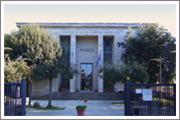
 National Museum. The national museum contains important objects and materials (funerary items, pots, etc.) found in the town, in the near necropolises and at the sanctuary dedicated to Hera Argiva at the mouth of Sele River. The only example of funerary painting is the Tomb of the diver of 490/480 b. C. The paintings of the tomb portray scenes from a symposium and a diver. National Museum. The national museum contains important objects and materials (funerary items, pots, etc.) found in the town, in the near necropolises and at the sanctuary dedicated to Hera Argiva at the mouth of Sele River. The only example of funerary painting is the Tomb of the diver of 490/480 b. C. The paintings of the tomb portray scenes from a symposium and a diver.
Remains of the sanctuary dedicated to Hera Argiva, built around 600 b. C.
"Telling museum" of Hera Argiva. This museum presents different interpretations of the homonymous sanctuary, an archaeological site made just of a few remains. The museum "tells" about this site, thanks to films, three-dimensional recreations, videos. Visitors live this experience as they were inside the excavations.
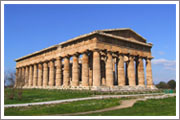 Temple of Poseidon or Neptune: it is the most beautiful example of Greek architecture in Western world. It was built in V century b.C. The temple has 6 front columns and 14 side columns. Temple of Poseidon or Neptune: it is the most beautiful example of Greek architecture in Western world. It was built in V century b.C. The temple has 6 front columns and 14 side columns.
"Sacello Ipogeico", built around VI century b.C.: it is maybe a small Greek temple dedicated to goddesses of fecundity and fertility. Or it is maybe a cenotaph (a symbolic tomb that does not contain a body). Inside many bronze pots were found.
Heraion, the temple dedicated to Hera, a big Doric building with grooved columns
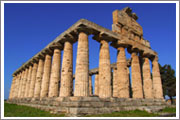 The temple dedicated to Cerere was built at the end of VI century b.C. with 6 front columns and 13 side columns. The temple has a unique feature: the tall pediment. The Doric frieze is very interesting: it is made of large calcareous blocks, with metopes. The temple dedicated to Cerere was built at the end of VI century b.C. with 6 front columns and 13 side columns. The temple has a unique feature: the tall pediment. The Doric frieze is very interesting: it is made of large calcareous blocks, with metopes.
Roman amphitheatre, used by gladiators. It was built around I century a.C.
Remains of aThesaurus, a small and ancient temple dedicated to Hera.
Cathedral dedicated to Madonna del Granato, whose worship recalls the Pagan cult of Hera Argiva. It was built in XI century.
Early-Christian Basilica (Church dedicated to Our Lady of the Annunciation), the most ancient Greek temple, built in VI century b. C. and dedicated to Hera, that is Juno. The temple has 9 front columns and 18 side columns.
|


